Transitions between standard temples and elastic head strap
CLEVELAND—1980s kids are familiar with the phrase “Transformers—more than meets the eye.” Brass Knuckle® Transformer (BKDST-1040NP) offers versatile protection when something tries to meet the eyes and shouldn’t—like debris and fog. These glasses quickly transition from standard temples to an elastic head strap. Integrated side protection remains and so does the exclusive BK-Anti-FOG+ protection.
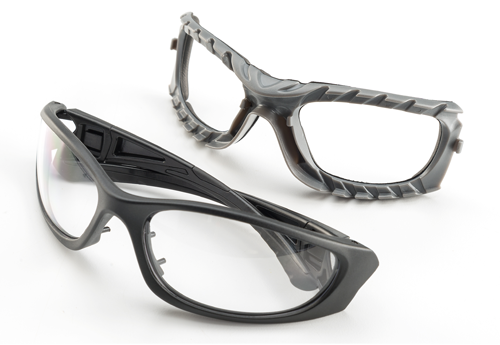
The Transformer provides optimal, prime protection for work environments in which prevention of particle ingress is a ‘sometimes’ need, and anti-fog and comfortable fit are an ‘always’ need. Think of construction sites where workers are sanding, grinding, and cutting only part of the time, as the hot sun beats down all day long.
Transformer has rugged good looks, with a nylon and TPR frame, and black/dark gray temples. The durable polycarbonate lens features Brass Knuckle’s proprietary BK-Anti-FOG+ coating, offering superior performance under the most demanding hot and humid conditions.
BK-Anti-FOG+ is tested under the most stringent anti-fog standard in the world, exceeding the European EN 166/168. Its anti-fog properties last an astounding 45 times longer than the minimum set forth by the standard—rendering this eyewear virtually fog-free.
The 8 base curve polycarbonate lens offers unobstructed field of vision and high-impact protection, while the built-in dust filter forms a seal to keep out dust and airborne particles. The filter protects workers from intense wind, sun, dirt, dust and debris, as well as high heat and humidity. Soft nylon and thermoplastic rubber (TPR) temples flex to adjust to wider facial profiles, helping to ensure these spectacles remain comfortable to wear without distorting the optics. It offers excellent abrasion, chemical, and UV resistance.